How the mbira makes its sound
In the Hornbostel–Sachs system, which classifies instruments by how they produce sound, the mbira belongs to the plucked idiophones (lamellophones): flexible tongues or lamellae are plucked – the mbira, kalimba, music box and jaw harp.
More broadly it is one of the idiophones, where the solid body of the instrument itself vibrates, without strings or a stretched membrane.
Press play above and watch the spectrum: the evenly spaced peaks are harmonics, and their relative strength is what gives the instrument its character.
From Wikipedia
Mbira, also known as kalimba and zanza (or variant spellings), are a family of musical instruments, traditional to the Shona people of Zimbabwe.
The instruments consist of a wooden board (often fitted with a resonator) with attached staggered metal tines, played by holding the instrument in the hands and plucking the tines with the thumbs and/or fingers. Musicologists classify it as a lamellaphone, part of the plucked idiophone family of musical instruments.
Other plucked idiophones

Jew's harp
Plucked idiophones (lamellophones)
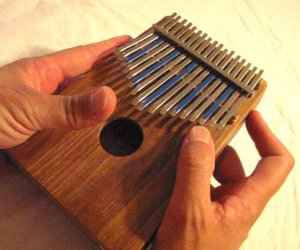
Lamellophone
Plucked idiophones (lamellophones)

Đàn môi
Plucked idiophones (lamellophones)

Kouxian
Plucked idiophones (lamellophones)

Ōtsuzumi
Plucked idiophones (lamellophones)
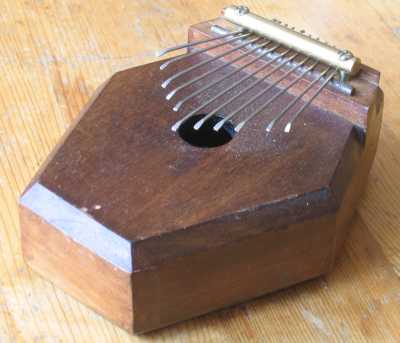
Kalimba
Plucked idiophones (lamellophones)
Agidigbo
Plucked idiophones (lamellophones)

Ikembe
Plucked idiophones (lamellophones)
Frequently asked questions
What does a mbira sound like?
As one of the plucked idiophones, its sound comes from the way flexible tongues or lamellae are plucked.
What type of instrument is the mbira?
It is classified as plucked idiophones (lamellophones) (Hornbostel–Sachs 122.1).
Where does the mbira come from?
The mbira originates from Zimbabwe and Malawi.
Sources & credits
- Wikidata Q1467960 – CC0
- Wikipedia: Mbira – CC BY-SA 4.0
- Image by Ji-Elle – CC BY-SA 4.0