How the jadagan makes its sound
In the Hornbostel–Sachs system, which classifies instruments by how they produce sound, the jadagan belongs to the board zithers: strings are stretched across a flat board or box – the family of the piano, harpsichord and hammered dulcimer.
More broadly it is one of the chordophones (string instruments), where sound comes from vibrating strings, amplified by a resonating body.
Players shape its sound through technique and materials; the resonating body filters the raw vibration, boosting some harmonics and damping others.
From Wikipedia
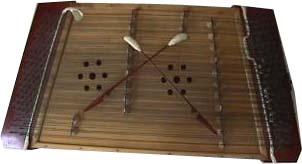
The jadagan (Khakas: чадыған, romanized: çadığan, Russian: чатхан, romanized: chatkhan, or Siberian harp) is a wooden board zither of the Khakas people in Siberia.
The jadagan usually has 6 or 7 strings stretched across movable bridges and tuned a fourth or fifth apart. The body is hollowed out from underneath like an upturned trough. It has a convex surface and an end bent towards the ground. The strings are plucked and the sound is very smooth. The length of the instrument is around 1.5 metres (59 in).
Other board zithers




Frequently asked questions
What does a jadagan sound like?
As one of the board zithers, its sound comes from the way strings are stretched across a flat board or box.
What type of instrument is the jadagan?
It is classified as board zithers (Hornbostel–Sachs 314.122).
Sources & credits
- Wikidata Q6121180 – CC0
- Wikipedia: Jadagan – CC BY-SA 4.0
- Image by Anadolu-olgy – CC0 1.0