How the langspil makes its sound
In the Hornbostel–Sachs system, which classifies instruments by how they produce sound, the langspil belongs to the board zithers: strings are stretched across a flat board or box – the family of the piano, harpsichord and hammered dulcimer.
More broadly it is one of the chordophones (string instruments), where sound comes from vibrating strings, amplified by a resonating body.
Players shape its sound through technique and materials; the resonating body filters the raw vibration, boosting some harmonics and damping others.
From Wikipedia
The langspil is a traditional Icelandic drone zither. It has a single melody string and usually 2 drone strings.
The langspil can be played by plucking the strings by hand, with a bow or by hammering. Langspils exist in two basic versions, straight and curved and are generally around the length of 80 cm (31 in), and can be as long as 104 cm (41 in) or as short as 73 cm (29 in). Many different types of wood have traditionally been used, including pine, fir, beechwood, birch, oak and walnut, since they were generally constructed from driftwood.
Other board zithers


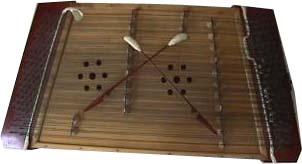


Frequently asked questions
What does a langspil sound like?
As one of the board zithers, its sound comes from the way strings are stretched across a flat board or box.
What type of instrument is the langspil?
It is classified as board zithers (Hornbostel–Sachs 314.122).
Sources & credits
- Wikidata Q1805401 – CC0
- Wikipedia: Langspil – CC BY-SA 4.0
- Image by Jo Dusepo – CC BY-SA 4.0