How the Marxophone makes its sound
In the Hornbostel–Sachs system, which classifies instruments by how they produce sound, the Marxophone belongs to the board zithers: strings are stretched across a flat board or box – the family of the piano, harpsichord and hammered dulcimer.
More broadly it is one of the chordophones (string instruments), where sound comes from vibrating strings, amplified by a resonating body.
Players shape its sound through technique and materials; the resonating body filters the raw vibration, boosting some harmonics and damping others.
From Wikipedia
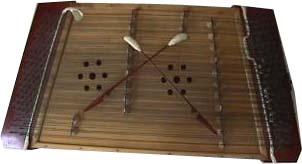
The Marxophone is a fretless zither played via a system of metal hammers. It features two octaves of double melody strings in the key of C major (middle C to C''), and four sets of chord strings (C major, G major, F major, and D7). Sounding somewhat like a mandolin, the Marxophone's timbre is also reminiscent of various types of hammered dulcimers.
The player typically strums the chords with the left hand. The right hand plays the melody strings by depressing spring steel strips that hold small lead hammers over the strings. A brief stab on a metal strip bounces the hammer off a string pair to produce a single note. Holding the strip down makes the hammer bounce on the double strings, which produces a mandolin-like tremolo. The bounce rate is somewhat fixed, as it is based on the spring steel strip length, hammer weight, and string tension—but a player can increase the rate slightly by pressing higher on the strip, effectively moving its pivot point closer to the lead hammer.
Other board zithers




Frequently asked questions
What does the Marxophone sound like?
As one of the board zithers, its sound comes from the way strings are stretched across a flat board or box.
What type of instrument is the Marxophone?
It is classified as board zithers (Hornbostel–Sachs 314.122).
Sources & credits
- Wikidata Q3296114 – CC0
- Wikipedia: Marxophone – CC BY-SA 4.0
- Image by Badagnani at en.wikipedia – CC BY-SA 3.0