Listen to the monochord
Tip: press play to see the sound's live frequency spectrum in blue over the waveform.
How the monochord makes its sound
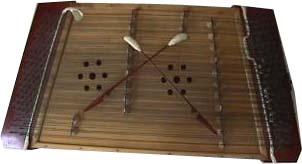
In the Hornbostel–Sachs system, which classifies instruments by how they produce sound, the monochord belongs to the board zithers: strings are stretched across a flat board or box – the family of the piano, harpsichord and hammered dulcimer.
More broadly it is one of the chordophones (string instruments), where sound comes from vibrating strings, amplified by a resonating body.
Press play above and watch the spectrum: the evenly spaced peaks are harmonics, and their relative strength is what gives the instrument its character.
From Wikipedia
A monochord, also known as sonometer (see below), is an ancient musical and scientific laboratory instrument, involving one (mono-) string (chord). The term monochord is sometimes used as the class-name for any musical stringed instrument having only one string and a stick shaped body, also known as musical bows. According to the Hornbostel–Sachs system, string bows are bar zithers (311.1) while monochords are traditionally board zithers (314). The "harmonical canon", or monochord is, at its least, "merely a string having a board under it of exactly the same length, upon which may be delineated the points at which the string must be stopped to give certain notes," allowing comparison.
Other board zithers




Frequently asked questions
What does a monochord sound like?
Listen to 1 recording on this page. As one of the board zithers, its sound comes from the way strings are stretched across a flat board or box.
What type of instrument is the monochord?
It is classified as board zithers (Hornbostel–Sachs 314.122).
Sources & credits
- Monochord by Hadi – CC0 1.0 · Wikimedia Commons
- Wikidata Q1136653 – CC0
- Wikipedia: Monochord – CC BY-SA 4.0
- Image by Heinz Schmitz – CC BY-SA 2.5