Listen to the psalmodicon
Tip: press play to see the sound's live frequency spectrum in blue over the waveform.
How the psalmodicon makes its sound
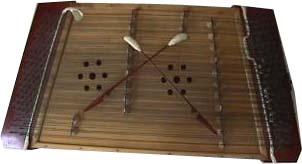
In the Hornbostel–Sachs system, which classifies instruments by how they produce sound, the psalmodicon belongs to the board zithers: strings are stretched across a flat board or box – the family of the piano, harpsichord and hammered dulcimer.
More broadly it is one of the chordophones (string instruments), where sound comes from vibrating strings, amplified by a resonating body.
Press play above and watch the spectrum: the evenly spaced peaks are harmonics, and their relative strength is what gives the instrument its character.
From Wikipedia
The psalmodicon (psalmodikon or salmodikon) is a stringed musical instrument a type of Monochord; the most common variants have a single string. It was developed in Scandinavia for simplifying music in churches and schools, and as an alternative to the fiddle for sacred music. The instrument could be plucked or bowed. Beginning in the early 19th century, it was adopted by many rural churches in Scandinavia; later, immigrants brought the instrument to the United States.
Other board zithers




Frequently asked questions
What does a psalmodicon sound like?
Listen to 1 recording on this page. As one of the board zithers, its sound comes from the way strings are stretched across a flat board or box.
What type of instrument is the psalmodicon?
It is classified as board zithers (Hornbostel–Sachs 314.122).
Sources & credits
- I denna ljuva sommartid - SMV - SVA BB 5320 03 – CC0 1.0 · Wikimedia Commons
- Wikidata Q3354977 – CC0
- Wikipedia: Psalmodicon – CC BY-SA 4.0
- Image by K. Frisk – CC BY-SA 3.0