How the tautirut makes its sound
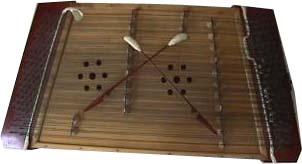
In the Hornbostel–Sachs system, which classifies instruments by how they produce sound, the tautirut belongs to the board zithers: strings are stretched across a flat board or box – the family of the piano, harpsichord and hammered dulcimer.
More broadly it is one of the chordophones (string instruments), where sound comes from vibrating strings, amplified by a resonating body.
Press play above and watch the spectrum: the evenly spaced peaks are harmonics, and their relative strength is what gives the instrument its character.
From Wikipedia
The tautirut (Inuktitut syllabics: ᑕᐅᑎᕈᑦ or tautiruut, also known as the Eskimo fiddle) is a bowed zither native to the Inuit culture of Canada.
Lucien M. Turner described the "Eskimo violin" in 1894 as being...made of birch or spruce, and the two strings are of coarse, loosely twisted sinew. The bow has a strip of whalebone in place of horsehair, and is resined with spruce gum. This fiddle is held across the lap when played.
Other board zithers




Frequently asked questions
What does a tautirut sound like?
As one of the board zithers, its sound comes from the way strings are stretched across a flat board or box.
What type of instrument is the tautirut?
It is classified as board zithers (Hornbostel–Sachs 314.122-71).
Sources & credits
- Wikidata Q2405825 – CC0
- Wikipedia: Tautirut – CC BY-SA 4.0
- Image – Public domain