How the tsymbaly makes its sound
In the Hornbostel–Sachs system, which classifies instruments by how they produce sound, the tsymbaly belongs to the board zithers: strings are stretched across a flat board or box – the family of the piano, harpsichord and hammered dulcimer.
More broadly it is one of the chordophones (string instruments), where sound comes from vibrating strings, amplified by a resonating body.
Players shape its sound through technique and materials; the resonating body filters the raw vibration, boosting some harmonics and damping others.
From Wikipedia
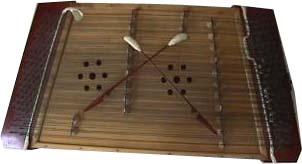
The tsymbaly (Ukrainian: цимбали) is the Ukrainian version of the hammer dulcimer. It is a chordophone made up of a trapezoidal box with metal (steel or bronze) strings strung across it. The tsymbaly is played by striking two beaters against the strings.
The strings are strung in groups of 3–5, which are tuned in unison. The bass strings may have 1 or 2 wrapped strings tuned in union. The beaters were quite short in comparison to those used by the Cymbalom although not as short as those of the Belarus variety. Traditionally they had leather wrappings rather than the cotton wrap used by Hungarian and Romanian players.
Other board zithers




More instruments from Ukraine

Frequently asked questions
What does a tsymbaly sound like?
As one of the board zithers, its sound comes from the way strings are stretched across a flat board or box.
What type of instrument is the tsymbaly?
It is classified as board zithers (Hornbostel–Sachs 314.122-4).
Where does the tsymbaly come from?
The tsymbaly originates from Ukraine.
Sources & credits
- Wikidata Q17099625 – CC0
- Wikipedia: Tsymbaly – CC BY-SA 4.0
- Image by Unknown prewar photographers – Public domain