How the yangqin makes its sound
In the Hornbostel–Sachs system, which classifies instruments by how they produce sound, the yangqin belongs to the board zithers: strings are stretched across a flat board or box – the family of the piano, harpsichord and hammered dulcimer.
More broadly it is one of the chordophones (string instruments), where sound comes from vibrating strings, amplified by a resonating body.
Press play above and watch the spectrum: the evenly spaced peaks are harmonics, and their relative strength is what gives the instrument its character.
From Wikipedia
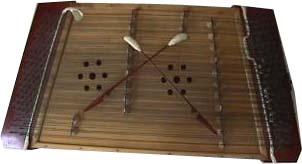
The trapezoidal yangqin (simplified Chinese: 扬琴; traditional Chinese: 揚琴; pinyin: yángqín; Jyutping: joeng4 kam4) is a Chinese hammered dulcimer, likely derived from the Iranian santur or the European dulcimer. It used to be written with the characters 洋琴 (lit. "foreign zither"), but the first character was changed in the early 20th century to 揚, meaning "acclaimed". It is also spelled yang ch'in. Hammered dulcimers of various types are now very popular not only in China, but also Eastern Europe, the Middle East, India, Iran, and Pakistan. The instruments are also sometimes known by the names "santoor" and "cymbalom". This instrument had an influence on the Thai classical instrument, known as Khim (ขิม).
Other board zithers




Frequently asked questions
What does a yangqin sound like?
As one of the board zithers, its sound comes from the way strings are stretched across a flat board or box.
What type of instrument is the yangqin?
It is classified as board zithers (Hornbostel–Sachs 314.122-4).
Sources & credits
- Wikidata Q877239 – CC0
- Wikipedia: Yangqin – CC BY-SA 4.0
- Image by jowcol61 – CC BY 2.0