Listen to the djembe
Tip: press play to see the sound's live frequency spectrum in blue over the waveform.
How the djembe makes its sound
In the Hornbostel–Sachs system, which classifies instruments by how they produce sound, the djembe belongs to the struck drums: a stretched membrane (drumhead) is struck with hands or beaters.
More broadly it is one of the membranophones (drums), where sound comes from a vibrating stretched membrane.
Players shape its sound through technique and materials; the resonating body filters the raw vibration, boosting some harmonics and damping others.
From Wikipedia
A djembe or jembe is a rope-tuned, skin-covered goblet drum played with bare hands from the Sabar family, originally from Senegal that is widely used in West Africa.
According to the Bambara people in Mali, the name "djembe" comes from the saying "Anke djé, anke bé," which translates to "everyone gather together in peace" and defines the drum's purpose. In the Bambara language, "djé" is the verb for "gather" and "bé" translates as "peace."
Other struck drums


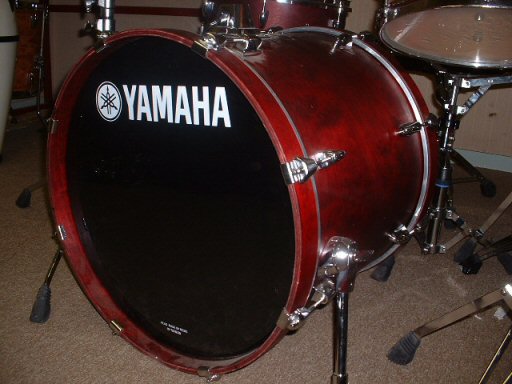


Questions people ask
Real questions from the Stack Exchange community – follow a link to read the discussion.
- Miking a djembe · Sound Design SE
Frequently asked questions
What does a djembe sound like?
Listen to 1 recording on this page. As one of the struck drums, its sound comes from the way a stretched membrane (drumhead) is struck with hands or beaters.
What type of instrument is the djembe?
It is classified as struck drums (Hornbostel–Sachs 211.261.1).
Sources & credits
- Ceramic Djembe by RutgerMuller – CC0 1.0 · Wikimedia Commons
- Wikidata Q537750 – CC0
- Wikipedia: Djembe – CC BY-SA 4.0
- Image by Edwin1971 at Dutch Wikipedia – CC BY-SA 3.0