How the Kafir harp makes its sound
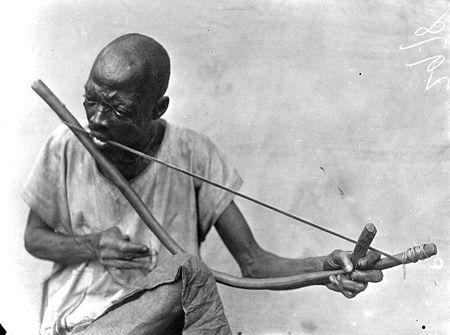
In the Hornbostel–Sachs system, which classifies instruments by how they produce sound, the Kafir harp belongs to the bar zithers: strings are stretched along a rigid bar or stick, often with a gourd resonator.
More broadly it is one of the chordophones (string instruments), where sound comes from vibrating strings, amplified by a resonating body.
Press play above and watch the spectrum: the evenly spaced peaks are harmonics, and their relative strength is what gives the instrument its character.
From Wikipedia
The Kafir harp is a traditional four- or five-stringed arched harp used by the Nuristanis native to the Nuristan Province of northeastern Afghanistan and Lower Chitral District of northwestern Pakistan. It is played during social gatherings, and to accompany epic storytelling or songs of heroic tales.
Similar harps used to be widespread in ancient times throughout Central Asia and India, and this harp possibly entered Afghanistan during the spread of Buddhism across the region but today the waji is not used in any other part of Afghanistan. It has been compared to the ennanga of Uganda and harp designs used in Sumer and ancient Egypt as far back as 3000 BC.
Other bar zithers



Frequently asked questions
What does the Kafir harp sound like?
As one of the bar zithers, its sound comes from the way strings are stretched along a rigid bar or stick, often with a gourd resonator.
What type of instrument is the Kafir harp?
It is classified as bar zithers (Hornbostel–Sachs 311.121.21).
Sources & credits
- Wikidata Q2540826 – CC0
- Wikipedia: Kafir harp – CC BY-SA 4.0
- Image by Jacqke – CC BY-SA 4.0