How the lesiba makes its sound
In the Hornbostel–Sachs system, which classifies instruments by how they produce sound, the lesiba belongs to the bar zithers: strings are stretched along a rigid bar or stick, often with a gourd resonator.
More broadly it is one of the chordophones (string instruments), where sound comes from vibrating strings, amplified by a resonating body.
Players shape its sound through technique and materials; the resonating body filters the raw vibration, boosting some harmonics and damping others.
From Wikipedia
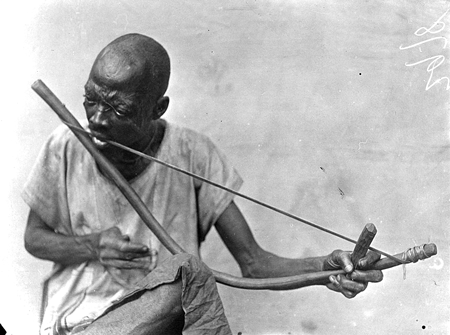
The term lesiba (Tswana for 'feather') refers to a class of "unbraced mouth-resonated bow[s]" with a flattened quill attached to a long string, stretched over a hard stick, acting as the main source of vibration. Holding both hands around the quill, positioned without touching just inside the lips, the player sharply inhales or exhales against it, creating vibration in the string. This "produces a powerful buzzing sound," usually in short notes on a small, limited scale.
Inhalation excites the harmonics of the string, while exhalation is most often accompanied by a throaty grunt, except in players with strong breath, and may be accompanied by humming. Vocalizations create, from a single player, the effect of more than one part. The harmonics used are primarily the fifth, sixth, seventh, eighth, ninth, tenth, and twelfth. The lesiba's construction is unique: "no other class of stringed-wind instrument has been found anywhere else in the world."
Other bar zithers



Frequently asked questions
What does a lesiba sound like?
As one of the bar zithers, its sound comes from the way strings are stretched along a rigid bar or stick, often with a gourd resonator.
What type of instrument is the lesiba?
It is classified as bar zithers (Hornbostel–Sachs 311.121.222).
Sources & credits
- Wikidata Q1540173 – CC0
- Wikipedia: Lesiba – CC BY-SA 4.0
- Image by ProjectExplorer LTD – CC BY 3.0