How the 17-string koto makes its sound
In the Hornbostel–Sachs system, which classifies instruments by how they produce sound, the 17-string koto belongs to the tube zithers: strings run along the surface of a tube, such as a length of bamboo.
More broadly it is one of the chordophones (string instruments), where sound comes from vibrating strings, amplified by a resonating body.
Players shape its sound through technique and materials; the resonating body filters the raw vibration, boosting some harmonics and damping others.
From Wikipedia
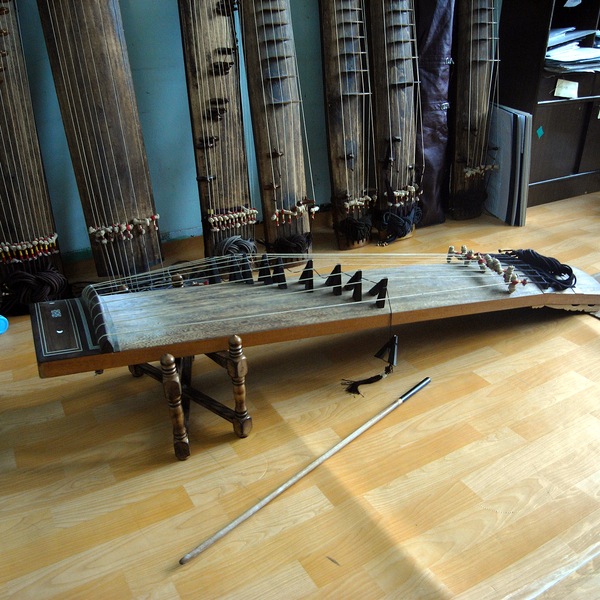
The 17-string koto (Japanese: 十七絃 or 十七弦, Hepburn: jūshichi-gen; "seventeen strings") is a variant of the koto with 17 strings instead of the typical 13.
The instrument is also known as jūshichi-gensō (十七絃箏), "17 stringed koto", or "bass koto" (although koto with a greater number of strings also exist). The jūshichi-gen was invented in 1921 by Michio Miyagi, a musician who felt that the standard koto lacked the range he sought in a traditional instrument. His 17 string creation, sometimes described as a "bass koto", has a deeper sound and requires specialized plectra; traditional koto plectra are worn attached to the player's fingers, with which the strings are plucked. Though his original jūshichi-gen was considerably larger than a normal koto, 17 stringed koto of a similar size to the average koto are more common today, though they do not have as deep a sound as the larger version.
Other tube zithers



Frequently asked questions
What does the 17-string koto sound like?
As one of the tube zithers, its sound comes from the way strings run along the surface of a tube, such as a length of bamboo.
What type of instrument is the 17-string koto?
It is classified as tube zithers (Hornbostel–Sachs 312.22).