Listen to the guqin
Tip: press play to see the sound's live frequency spectrum in blue over the waveform.
How the guqin makes its sound
In the Hornbostel–Sachs system, which classifies instruments by how they produce sound, the guqin belongs to the tube zithers: strings run along the surface of a tube, such as a length of bamboo.
More broadly it is one of the chordophones (string instruments), where sound comes from vibrating strings, amplified by a resonating body.
Players shape its sound through technique and materials; the resonating body filters the raw vibration, boosting some harmonics and damping others.
From Wikipedia
The guqin is a plucked seven-string Chinese musical instrument. It has been played since ancient times, and has traditionally been favoured by scholars and literati as an instrument of great subtlety and refinement, as highlighted by the quote "a gentleman does not part with his qin or se without good reason," as well as being associated with the ancient Chinese philosopher Confucius. It is sometimes referred to by the Chinese as "the father of Chinese music" or "the instrument of the sages". The guqin is not to be confused with the guzheng, another Chinese long stringed instrument also without frets, but with moveable bridges under each string.
Other tube zithers


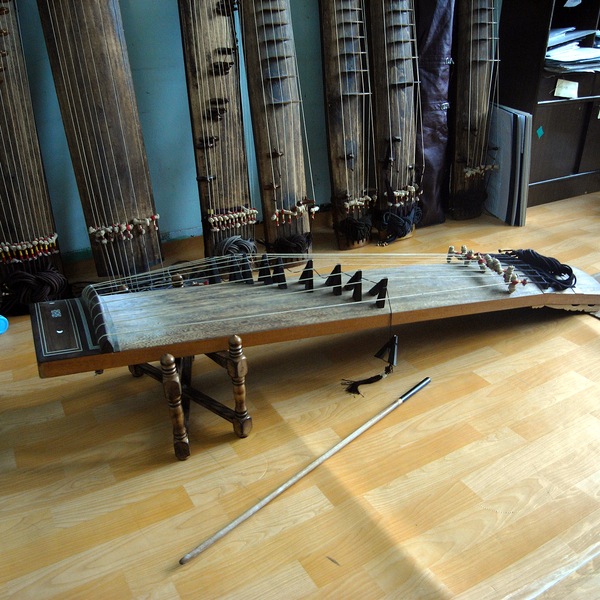


More instruments from China


Frequently asked questions
What does a guqin sound like?
Listen to 1 recording on this page. As one of the tube zithers, its sound comes from the way strings run along the surface of a tube, such as a length of bamboo.
What type of instrument is the guqin?
It is classified as tube zithers (Hornbostel–Sachs 312.22).
Where does the guqin come from?
The guqin originates from China.
Sources & credits
- Guqin-Zuiyu Changwan by CharlieHuang – CC BY-SA 3.0 · Wikimedia Commons
- Wikidata Q723720 – CC0
- Wikipedia: Guqin – CC BY-SA 4.0
- Image by The original uploader was CharlieHuang at English Wikipedia . – CC BY-SA 3.0