Listen to the koto
Tip: press play to see the sound's live frequency spectrum in blue over the waveform.
How the koto makes its sound
In the Hornbostel–Sachs system, which classifies instruments by how they produce sound, the koto belongs to the tube zithers: strings run along the surface of a tube, such as a length of bamboo.
More broadly it is one of the chordophones (string instruments), where sound comes from vibrating strings, amplified by a resonating body.
Players shape its sound through technique and materials; the resonating body filters the raw vibration, boosting some harmonics and damping others.
From Wikipedia
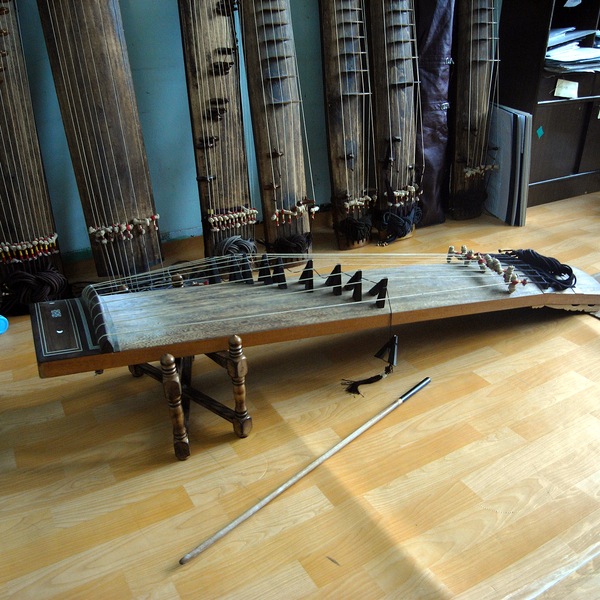
The koto (箏 or 琴) is a Japanese plucked half-tube zither instrument, and the national instrument of Japan. It is derived from the Chinese zheng and se, and similar to the Mongolian yatga, the Korean gayageum and ajaeng, the Vietnamese đàn tranh, the Sundanese kacapi and the Kazakh jetigen. Koto are roughly 180 centimetres (6 ft) in length, and made from Paulownia wood (Paulownia tomentosa, known as kiri). The most common type uses 13 strings strung over movable bridges used for tuning, different pieces possibly requiring different tuning. Seventeen-string koto are also common, and act as bass in ensembles. Koto strings are generally plucked using three fingerpicks (tsume), worn on the first three fingers of the right hand.
Other tube zithers




Frequently asked questions
What does a koto sound like?
Listen to 2 recordings on this page. As one of the tube zithers, its sound comes from the way strings run along the surface of a tube, such as a length of bamboo.
What type of instrument is the koto?
It is classified as tube zithers (Hornbostel–Sachs 312.22-6).
Sources & credits
- Koto performance by Torsodog – CC BY 3.0 · Wikimedia Commons
- Koto is home in Finnish (Antti Luode) by Antti Luode – CC BY 3.0 · Wikimedia Commons
- Wikidata Q289037 – CC0
- Wikipedia: Koto (instrument) – CC BY-SA 4.0
- Image by Jean-Pierre Dalbéra – CC BY 2.0