Listen to the guzheng
Tip: press play to see the sound's live frequency spectrum in blue over the waveform.
How the guzheng makes its sound
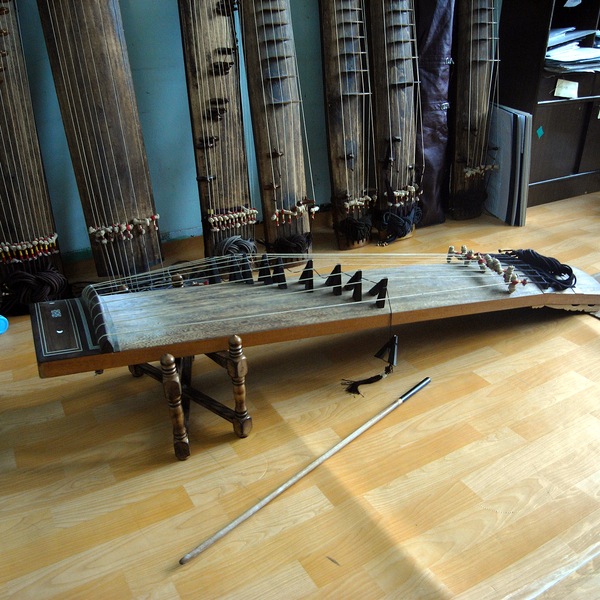
In the Hornbostel–Sachs system, which classifies instruments by how they produce sound, the guzheng belongs to the tube zithers: strings run along the surface of a tube, such as a length of bamboo.
More broadly it is one of the chordophones (string instruments), where sound comes from vibrating strings, amplified by a resonating body.
Players shape its sound through technique and materials; the resonating body filters the raw vibration, boosting some harmonics and damping others.
From Wikipedia
The zheng (pinyin: zhēng), or guzheng (Chinese: 古筝; pinyin: gǔzhēng; lit. 'ancient zheng'), is a Chinese plucked zither. The modern guzheng commonly has 21, 25, or 26 strings, is 64 inches (1.6 m; 5 ft 4 in) long, and is tuned in a major pentatonic scale. It has a large, resonant soundboard made from Paulownia wood. Other components are often made from other woods for structural or decorative reasons. Guzheng players often wear a fingerpick made from materials such as plastic, resin, tortoiseshell, or ivory on one or both hands.
It can have nylon, steel, or silk strings depending on the genre. The most common guzheng has 21 strings. The high-pitched strings of the guzheng are close to the player, and the low-pitched strings are on the opposite side. The strings' order from the inside to the outside is 1 to 21.
Other tube zithers




More instruments from People's Republic of China


Frequently asked questions
What does a guzheng sound like?
Listen to 3 recordings on this page. As one of the tube zithers, its sound comes from the way strings run along the surface of a tube, such as a length of bamboo.
What type of instrument is the guzheng?
It is classified as tube zithers (Hornbostel–Sachs 312.22-5).
Where does the guzheng come from?
The guzheng originates from People's Republic of China.
Sources & credits
- My name is Zheng Zheng GuZheng (Antti Luode) by Antti Luode – CC BY 3.0 · Wikimedia Commons
- Guzheng Morning (Antti Luode) by Antti Luode – CC BY 3.0 · Wikimedia Commons
- Senor Guzheng and the Happy Monks (Antti Luode) by Antti Luode – CC BY 3.0 · Wikimedia Commons
- Wikidata Q726303 – CC0
- Wikipedia: Guzheng – CC BY-SA 4.0
- Image by Toglenn – CC BY-SA 4.0