How the Gayageum makes its sound
In the Hornbostel–Sachs system, which classifies instruments by how they produce sound, the Gayageum belongs to the tube zithers: strings run along the surface of a tube, such as a length of bamboo.
More broadly it is one of the chordophones (string instruments), where sound comes from vibrating strings, amplified by a resonating body.
Its timbre – the colour that lets you tell it apart from other instruments playing the same note – comes from the mix of overtones its body and resonator emphasise.
From Wikipedia
The gayageum or kayagum (Korean: 가야금; Hanja: 伽倻琴) is a traditional Korean musical instrument. It is a plucked zither with 12 strings, though some more recent variants have 18, 21 or 25 strings. It is probably the best known traditional Korean musical instrument.
It is based on the Chinese guzheng and is similar to the Japanese koto, Mongolian yatga, Vietnamese đàn tranh, Sundanese kacapi and Kazakh jetigen.
Other tube zithers


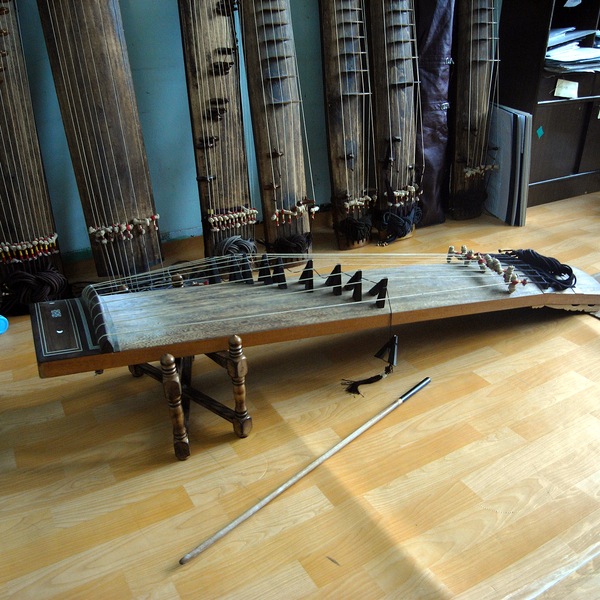


More instruments from Korea


Frequently asked questions
What does the Gayageum sound like?
As one of the tube zithers, its sound comes from the way strings run along the surface of a tube, such as a length of bamboo.
What type of instrument is the Gayageum?
It is classified as tube zithers (Hornbostel–Sachs 312.22-5).
Where does the Gayageum come from?
The Gayageum originates from Korea.
Sources & credits
- Wikidata Q717407 – CC0
- Wikipedia: Gayageum – CC BY-SA 4.0
- Image by Visviva – Public domain