How the se makes its sound
In the Hornbostel–Sachs system, which classifies instruments by how they produce sound, the se belongs to the tube zithers: strings run along the surface of a tube, such as a length of bamboo.
More broadly it is one of the chordophones (string instruments), where sound comes from vibrating strings, amplified by a resonating body.
Players shape its sound through technique and materials; the resonating body filters the raw vibration, boosting some harmonics and damping others.
From Wikipedia
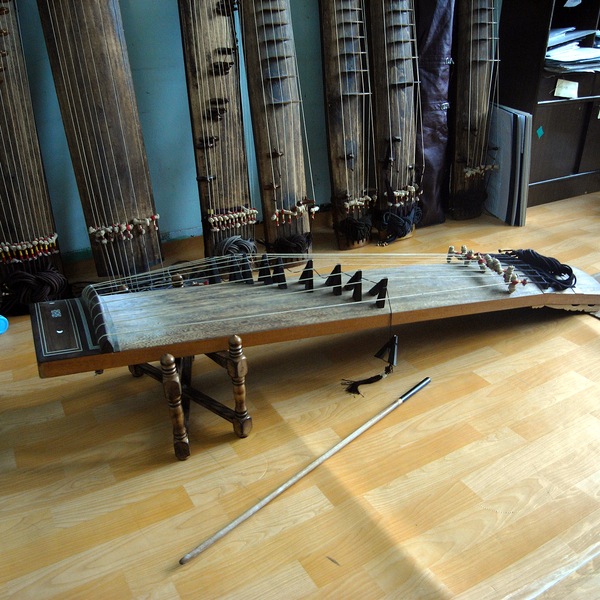
The se (Chinese: 瑟) or guse (Chinese: 古瑟) is an ancient plucked zither of Chinese origin. It varied in size and construction, but generally had 25–50 strings with moveable bridges and a range of up to five octaves. It was one of the most important stringed instruments in China, along with the guqin. The se gradually faded out of use, with only occasional attempts to revive it, such as Xiong Penglai’s 熊朋來 (1246-1323) publication of the Se Manual (sepu 瑟譜). The se was ultimately replaced by the similar zheng; modern reconstructions of the se resemble the zheng.
Other tube zithers



Frequently asked questions
What does a se sound like?
As one of the tube zithers, its sound comes from the way strings run along the surface of a tube, such as a length of bamboo.
What type of instrument is the se?
It is classified as tube zithers (Hornbostel–Sachs 312.22).
Sources & credits
- Wikidata Q1155980 – CC0
- Wikipedia: Se (instrument) – CC BY-SA 4.0
- Image by Zeze0729 – CC BY-SA 3.0