How the bajo sexto makes its sound
In the Hornbostel–Sachs system, which classifies instruments by how they produce sound, the bajo sexto belongs to the lutes: strings run parallel to a soundboard and along a neck – the family of the guitar, violin, sitar and oud.
More broadly it is one of the chordophones (string instruments), where sound comes from vibrating strings, amplified by a resonating body.
Press play above and watch the spectrum: the evenly spaced peaks are harmonics, and their relative strength is what gives the instrument its character.
From Wikipedia
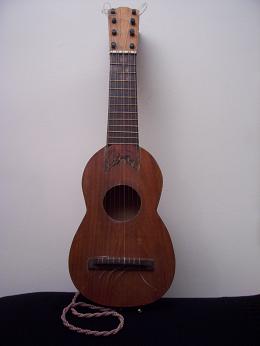
The bajo sexto (Spanish: "sixth bass") is a Mexican string instrument from the guitar family with 12 strings in six double courses.
It is played in a similar manner to the guitar, with the left hand changing the pitch with the frets on a fingerboard while the right hand plucks or strums the strings with or without a pick. Its original design was meant to accompany accordion players (and fiddlers) and thus offer a plethora of possibilities with only two musicians. This dynamic is a staple in regional Mexican styles, even with groups consisting of multiple instruments. The introduction of bass players eventually led to many players no longer using the lowest pair of strings. For that reason, the bajo sexto predates its close relative, the bajo quinto (Spanish: "fifth bass"), which eliminated the lowest pair of strings and only has 10 (five double courses).
Other lutes


More instruments from Mexico



Frequently asked questions
What does a bajo sexto sound like?
As one of the lutes, its sound comes from the way strings run parallel to a soundboard and along a neck.
What type of instrument is the bajo sexto?
It is classified as lutes (Hornbostel–Sachs 321.322-5).
Where does the bajo sexto come from?
The bajo sexto originates from Mexico.
Sources & credits
- Wikidata Q804161 – CC0
- Wikipedia: Bajo sexto – CC BY-SA 4.0
- Image by Emma dusepo – CC0 1.0