How the lira makes its sound
In the Hornbostel–Sachs system, which classifies instruments by how they produce sound, the lira belongs to the tube zithers: strings run along the surface of a tube, such as a length of bamboo.
More broadly it is one of the chordophones (string instruments), where sound comes from vibrating strings, amplified by a resonating body.
Press play above and watch the spectrum: the evenly spaced peaks are harmonics, and their relative strength is what gives the instrument its character.
From Wikipedia
The lira, or relia, (Ukrainian: ліра) is a Ukrainian variant of the hurdy-gurdy, an instrument which can trace its history back to the 10th century. Regarding the origins of the lira in the region there are two schools of thought:
The lira is an evolution of the medieval bowed lira of the Byzantine Empire, ancestor of most European bowed instruments. The Byzantine lira was possibly introduced into Ukraine through the various trade routes to Byzantium.
Other tube zithers


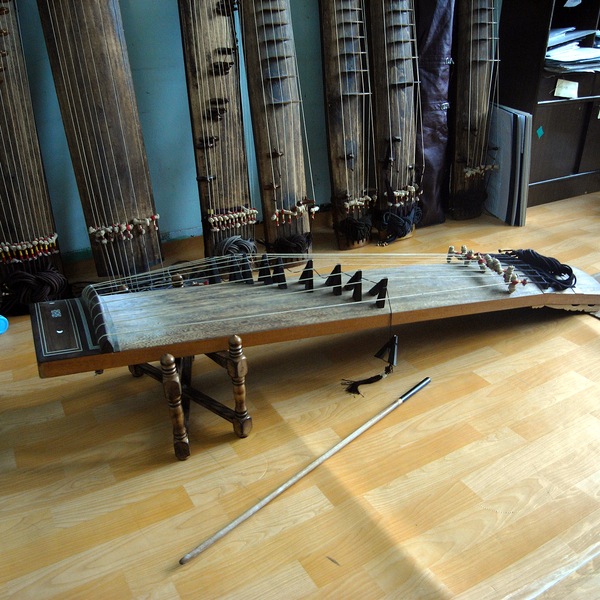

Frequently asked questions
What does a lira sound like?
As one of the tube zithers, its sound comes from the way strings run along the surface of a tube, such as a length of bamboo.
What type of instrument is the lira?
It is classified as tube zithers (Hornbostel–Sachs 312.322-72).
Sources & credits
- Wikidata Q874501 – CC0
- Wikipedia: Lira (Ukrainian instrument) – CC BY-SA 4.0
- Image by Kinedw – CC BY-SA 3.0