Listen to the Bagpipes
Tip: press play to see the sound's live frequency spectrum in blue over the waveform.
How the Bagpipes makes its sound
In the Hornbostel–Sachs system, which classifies instruments by how they produce sound, the Bagpipes belongs to the double-reed instruments: two reeds beat against each other – oboes, bassoons, shawms and the duduk.
More broadly it is one of the aerophones (wind instruments), where sound comes from vibrating air.
Press play above and watch the spectrum: the evenly spaced peaks are harmonics, and their relative strength is what gives the instrument its character.
From Wikipedia
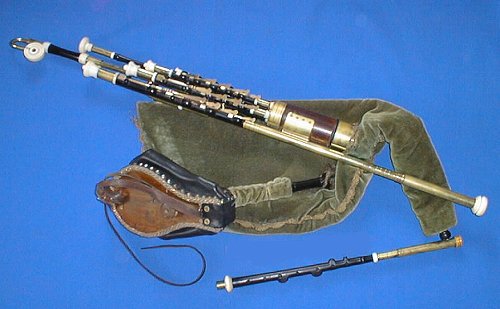
The bagpipe is a woodwind instrument using enclosed reeds fed from a constant reservoir of air in the form of a bag. The Scottish Great Highland bagpipe is well known, but people have played bagpipes for centuries throughout large parts of Europe, North Africa, West Asia, around the Persian Gulf and northern parts of South Asia.
The term bagpipes is also used, though pipers usually refer to the bagpipes as "the pipes", "a set of pipes" or "a stand of pipes".
Other double-reed instruments


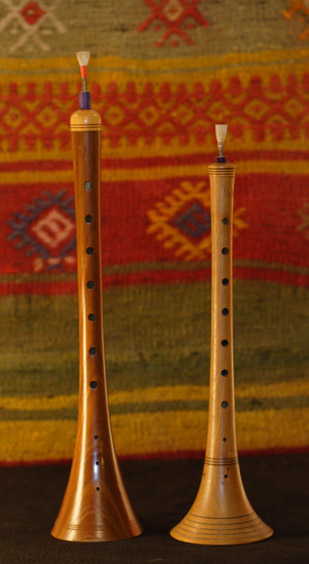


Frequently asked questions
What does the Bagpipes sound like?
Listen to 2 recordings on this page. As one of the double-reed instruments, its sound comes from the way two reeds beat against each other.
What type of instrument is the Bagpipes?
It is classified as double-reed instruments (Hornbostel–Sachs 422.112+422.22-62).
Sources & credits
- Mari Bagpipe - Erik Juzykain by Cseremisz Elian – CC BY-SA 3.0 · Wikimedia Commons
- Amazing Grace (bagpipe) - Pipe Band - United States Air Force Reserve Band by Composition: traditional; Performance: Sandy Jones (bagpipe), Scott Gunn (bagpipe), United States Air Force Reserve… – Public domain · Wikimedia Commons
- Wikidata Q8347 – CC0
- Wikipedia: Bagpipes – CC BY-SA 4.0
- Image by Lucas Kendall – CC BY-SA 4.0