How the uilleann pipes makes its sound
In the Hornbostel–Sachs system, which classifies instruments by how they produce sound, the uilleann pipes belongs to the double-reed instruments: two reeds beat against each other – oboes, bassoons, shawms and the duduk.
More broadly it is one of the aerophones (wind instruments), where sound comes from vibrating air.
Its timbre – the colour that lets you tell it apart from other instruments playing the same note – comes from the mix of overtones its body and resonator emphasise.
From Wikipedia
The uilleann pipes, also known as Union pipes and sometimes called Irish pipes, are the characteristic national bagpipe of Ireland. Their current name is a partial translation of the Irish language terms píobaí uilleann (literally, "pipes of the elbow"), from their method of inflation. There is no historical record of the name or use of the term uilleann pipes before the 20th century. The name was an invention of Grattan Flood and it stuck. People mistook the term "union" to refer to the 1800 Act of Union; however, this is incorrect as Breandán Breathnach points out that a poem published in 1796 uses the term "union".
Other double-reed instruments


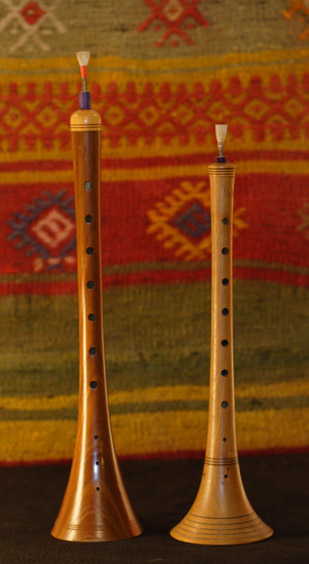


More instruments from Ireland


Frequently asked questions
What does an uilleann pipes sound like?
As one of the double-reed instruments, its sound comes from the way two reeds beat against each other.
What type of instrument is the uilleann pipes?
It is classified as double-reed instruments (Hornbostel–Sachs 422.122.2+422.221.1).
Where does the uilleann pipes come from?
The uilleann pipes originates from Ireland.
Sources & credits
- Wikidata Q543833 – CC0
- Wikipedia: Uilleann pipes – CC BY-SA 4.0
- Image by Ganainm – CC BY 3.0