Listen to the bassoon
Tip: press play to see the sound's live frequency spectrum in blue over the waveform.
How the bassoon makes its sound
In the Hornbostel–Sachs system, which classifies instruments by how they produce sound, the bassoon belongs to the double-reed instruments: two reeds beat against each other – oboes, bassoons, shawms and the duduk.
More broadly it is one of the aerophones (wind instruments), where sound comes from vibrating air.
Press play above and watch the spectrum: the evenly spaced peaks are harmonics, and their relative strength is what gives the instrument its character.
Range of the bassoon
The typical range of the bassoon runs from B♭1 (58.3 Hz) to E5 (659 Hz) – about 3.5 octaves. Harmonics extend its sound far higher.
From Wikipedia
The bassoon is a musical instrument in the woodwind family, which plays in the tenor and bass ranges. It is composed of six pieces, and is usually made of wood. It is known for its distinctive tone color, wide range, versatility, and virtuosity. It is a non-transposing instrument and typically its music is written in the bass and tenor clefs, and sometimes in the treble. There are two forms of modern bassoon: the Buffet (or French) and Heckel (or German) systems; the two have different fingering systems, as well as possessing subtle differences in timbre. It is typically played while sitting using a seat strap, but can be played while standing if the player has a harness to hold the instrument. Sound is produced by rolling both lips over the reed and blowing direct air pressure to cause the reed to vibrate. Its fingering system can be quite complex when compared to those of other instruments. Appearing in its modern form in the 19th century, the bassoon figures prominently in orchestral, concert band, and chamber music literature, and is occasionally heard in pop, rock, and jazz settings as well. One who plays a bassoon is called a bassoonist.
Other double-reed instruments


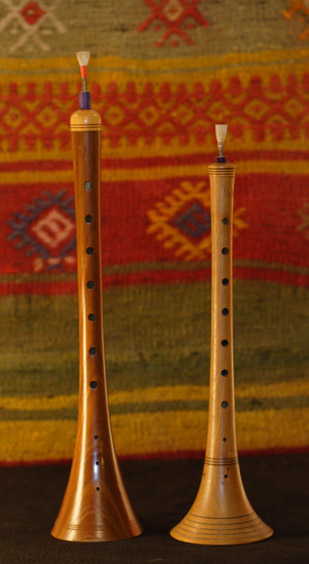


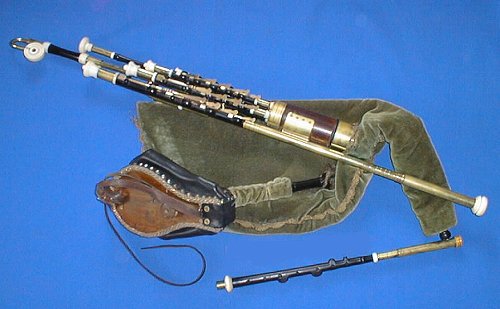
Frequently asked questions
What does a bassoon sound like?
Listen to 4 recordings on this page. As one of the double-reed instruments, its sound comes from the way two reeds beat against each other.
What type of instrument is the bassoon?
It is classified as double-reed instruments (Hornbostel–Sachs 422.112-71).
Sources & credits
- Bassoon-technical-articulations – GFDL 1.2 · Wikimedia Commons
- Clarinet and Bassoon by Qwertyxp2000 – CC BY-SA 4.0 · Wikimedia Commons
- Bassoon 02 by Mozart – CC0 1.0 · Wikimedia Commons
- Bassoon 01 by Mozart – CC0 1.0 · Wikimedia Commons
- Wikidata Q159998 – CC0
- Wikipedia: Bassoon – CC BY-SA 4.0
- Image by mark.drummer – CC BY 2.0