Listen to the Binioù
Tip: press play to see the sound's live frequency spectrum in blue over the waveform.
How the Binioù makes its sound
In the Hornbostel–Sachs system, which classifies instruments by how they produce sound, the Binioù belongs to the double-reed instruments: two reeds beat against each other – oboes, bassoons, shawms and the duduk.
More broadly it is one of the aerophones (wind instruments), where sound comes from vibrating air.
Its timbre – the colour that lets you tell it apart from other instruments playing the same note – comes from the mix of overtones its body and resonator emphasise.
From Wikipedia
The binioù is a type of bagpipe. The word binioù means 'bagpipe' in the Breton language.
There are two bagpipes called binioù in Brittany: the traditional binioù kozh, or biniou-bihan (kozh means 'old' in Breton; bihan means 'small'), and the binioù bras, or binioù braz (bras means 'big'), which was brought into Brittany from Scotland in the late 19th century. The oldest native bagpipe in Brittany is the veuze, from which the binioù kozh is thought to be derived.
Other double-reed instruments


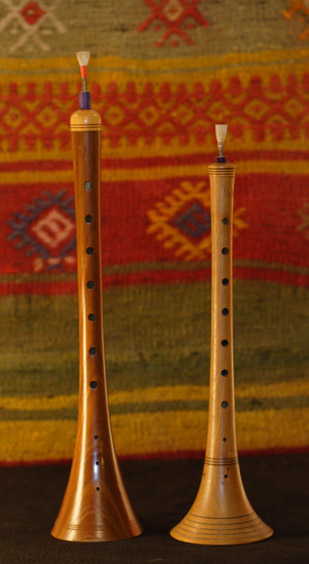


Frequently asked questions
What does the Binioù sound like?
Listen to 1 recording on this page. As one of the double-reed instruments, its sound comes from the way two reeds beat against each other.
What type of instrument is the Binioù?
It is classified as double-reed instruments (Hornbostel–Sachs 422.112).
Sources & credits
- Ladmirault - Variation sur des airs de biniou trégorois by Flopinot2012 – CC BY-SA 4.0 · Wikimedia Commons
- Wikidata Q863876 – CC0
- Wikipedia: Binioù – CC BY-SA 4.0
- Image by Limesle – Public domain