How the contraforte makes its sound
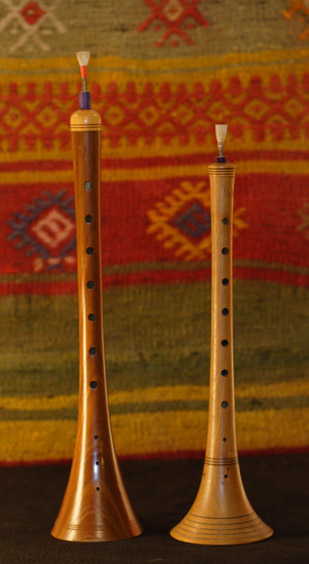
In the Hornbostel–Sachs system, which classifies instruments by how they produce sound, the contraforte belongs to the double-reed instruments: two reeds beat against each other – oboes, bassoons, shawms and the duduk.
More broadly it is one of the aerophones (wind instruments), where sound comes from vibrating air.
Players shape its sound through technique and materials; the resonating body filters the raw vibration, boosting some harmonics and damping others.
From Wikipedia
The contraforte (German: Kontraforte) is a proprietary instrument with a range similar to the contrabassoon produced by Benedikt Eppelsheim and Guntram Wolf. It is intended to have improved dynamics and intonation over the distinctive but sometimes reticent sound of the conventional contrabassoon. The contraforte uses a different and wider bore than the contrabassoon to produce a distinct tone; the sound is more even in strength and intonation across registers, remaining quite strong into the high register, unlike a contrabassoon. It also lacks the distinct "rattle" of a contrabassoon, although an appropriate reed design can replicate this effect where desired.
Wolf and Eppelsheim developed an accurate bore taper and precise key works in order to simplify fingerings despite the instrument's large size.
Other double-reed instruments




Frequently asked questions
What does a contraforte sound like?
As one of the double-reed instruments, its sound comes from the way two reeds beat against each other.
What type of instrument is the contraforte?
It is classified as double-reed instruments (Hornbostel–Sachs 422.112).
Sources & credits
- Wikidata Q3689094 – CC0
- Wikipedia: Contraforte – CC BY-SA 4.0
- Image by Galoppini – CC BY-SA 3.0