How the cornamuse makes its sound
In the Hornbostel–Sachs system, which classifies instruments by how they produce sound, the cornamuse belongs to the double-reed instruments: two reeds beat against each other – oboes, bassoons, shawms and the duduk.
More broadly it is one of the aerophones (wind instruments), where sound comes from vibrating air.
Its timbre – the colour that lets you tell it apart from other instruments playing the same note – comes from the mix of overtones its body and resonator emphasise.
From Wikipedia
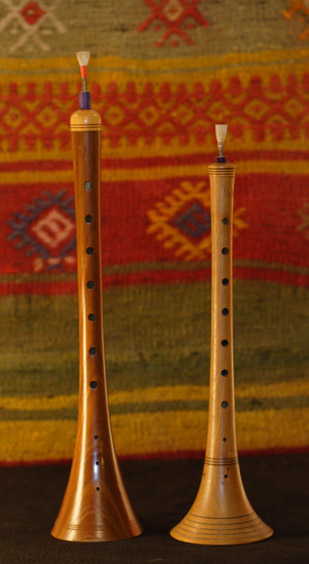
The cornamuse is a double reed instrument dating from the Renaissance period. It is similar to the crumhorn in having a windcap over the reed and cylindrical bore. The only evidence for the cornamuse comes from a description and a few comments by Michael Praetorius in Syntagma musicum II, published in 1619. Since the paragraph by Praetorius is the only clear description of the cornamuse and no period specimen or picture has been found, all reconstructions of the instrument rely on a certain amount of conjecture.
The text in German reads "Die CornaMuse sind gleich aus/und nicht mit doppelten/sondern mit einer einfachen Röhre/gleich den Bassanelli[…] aber unten zugedackt / und uff der seiten herumb etliche löcherlein / dadurch der Resonanz herausser gehet. Am klang seynd sie gar den Krumbhörnern gleich / nur dass sie stiller / lieblicher und gar sanft klingen […]"
Other double-reed instruments




Frequently asked questions
What does a cornamuse sound like?
As one of the double-reed instruments, its sound comes from the way two reeds beat against each other.
What type of instrument is the cornamuse?
It is classified as double-reed instruments (Hornbostel–Sachs 422.111).
Sources & credits
- Wikidata Q594256 – CC0
- Wikipedia: Cornamuse – CC BY-SA 4.0
- Image by Dulcijan – Public domain