Listen to the dulzaina
Tip: press play to see the sound's live frequency spectrum in blue over the waveform.
How the dulzaina makes its sound
In the Hornbostel–Sachs system, which classifies instruments by how they produce sound, the dulzaina belongs to the double-reed instruments: two reeds beat against each other – oboes, bassoons, shawms and the duduk.
More broadly it is one of the aerophones (wind instruments), where sound comes from vibrating air.
Its timbre – the colour that lets you tell it apart from other instruments playing the same note – comes from the mix of overtones its body and resonator emphasise.
From Wikipedia
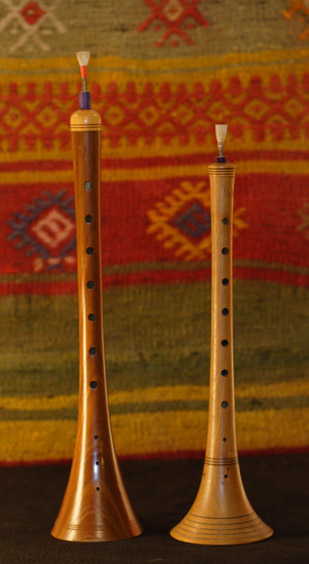
The dulzaina is a Spanish double reed instrument in the oboe family. It has a conical shape and is the equivalent of the Breton bombarde. It is often replaced by an oboe or a double reeded clarinet as seen in Armenian and Ukrainian folk music.
Many varieties of the dulzaina exist in Spain. In the Valencian Community, it is known as a dolçaina or xirimita and is accompanied by a drum called the tabalet. The Catalan variety of the dulzaina is called a gralla, and the Basque variety is called a bolin-gozo.
Other double-reed instruments




Frequently asked questions
What does a dulzaina sound like?
Listen to 1 recording on this page. As one of the double-reed instruments, its sound comes from the way two reeds beat against each other.
What type of instrument is the dulzaina?
It is classified as double-reed instruments (Hornbostel–Sachs 422.113).
Sources & credits
- Xavi Richart - Muixeranga (low quality) by Xavier Richart – CC BY 2.0 · Wikimedia Commons
- Wikidata Q1264870 – CC0
- Wikipedia: Dulzaina – CC BY-SA 4.0
- Image by Soinuenea – CC BY-SA 4.0