How the gyaling makes its sound
In the Hornbostel–Sachs system, which classifies instruments by how they produce sound, the gyaling belongs to the double-reed instruments: two reeds beat against each other – oboes, bassoons, shawms and the duduk.
More broadly it is one of the aerophones (wind instruments), where sound comes from vibrating air.
Press play above and watch the spectrum: the evenly spaced peaks are harmonics, and their relative strength is what gives the instrument its character.
From Wikipedia
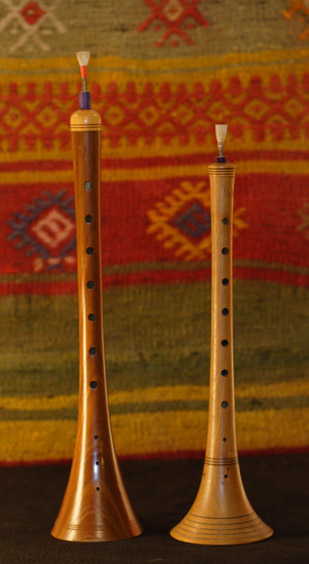
The gyaling (Tibetan: རྒྱ་གླིང་།, Wylie: rgya gling, English: also spelled gya ling, gya-ling, jahlin, jah-lin, jahling, jah-ling, rgya-gling etc.), literally "Indian trumpet", is a traditional woodwind instrument used in Tibet. As its name indicates, it is the Chinese double reed Suona horn (much like the Iranian sorna) used mainly in Tibetan monasteries during puja (chanting and prayer) and is associated with peaceful deities and the idea of devotion.
Other double-reed instruments




Frequently asked questions
What does a gyaling sound like?
As one of the double-reed instruments, its sound comes from the way two reeds beat against each other.
What type of instrument is the gyaling?
It is classified as double-reed instruments (Hornbostel–Sachs 422.112).
Sources & credits
- Wikidata Q1127899 – CC0
- Wikipedia: Gyaling – CC BY-SA 4.0
- Image by Collecties van het Nationaal Museum van Wereldculturen en het Wereldmuseum – CC BY-SA 4.0