How the Hirtenschalmei makes its sound
In the Hornbostel–Sachs system, which classifies instruments by how they produce sound, the Hirtenschalmei belongs to the double-reed instruments: two reeds beat against each other – oboes, bassoons, shawms and the duduk.
More broadly it is one of the aerophones (wind instruments), where sound comes from vibrating air.
Press play above and watch the spectrum: the evenly spaced peaks are harmonics, and their relative strength is what gives the instrument its character.
From Wikipedia
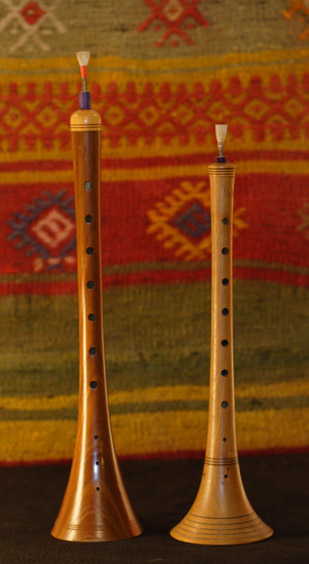
The Hirtenschalmei (or shepherd's shawm) is a double reeded woodwind instrument, with a cylindrical bore and a flared bell, reconstructed based on iconographic sources in the late 20th century. The instrument is described as producing a "buzzy" sound. The Hirtenschalmei tends to be quieter than a shawm. The double reed in the instrument is capped. The instrument is often mentioned in medieval French literature and art, depicted as being played by rustic figures.
All instances of the instruments today are reconstructed based on an instrument found on the wreck of the Mary Rose, during salvage operations in the 1980s. However, this instrument could also have been dulzaina. Today, reconstructions are made in soprano, tenor and alto sizes.
Other double-reed instruments




Frequently asked questions
What does the Hirtenschalmei sound like?
As one of the double-reed instruments, its sound comes from the way two reeds beat against each other.
What type of instrument is the Hirtenschalmei?
It is classified as double-reed instruments (Hornbostel–Sachs 422.111).
Sources & credits
- Wikidata Q5771718 – CC0
- Wikipedia: Hirtenschalmei – CC BY-SA 4.0
- Image by Houston Public Media – Public domain