How the mizmar makes its sound
In the Hornbostel–Sachs system, which classifies instruments by how they produce sound, the mizmar belongs to the double-reed instruments: two reeds beat against each other – oboes, bassoons, shawms and the duduk.
More broadly it is one of the aerophones (wind instruments), where sound comes from vibrating air.
Press play above and watch the spectrum: the evenly spaced peaks are harmonics, and their relative strength is what gives the instrument its character.
From Wikipedia
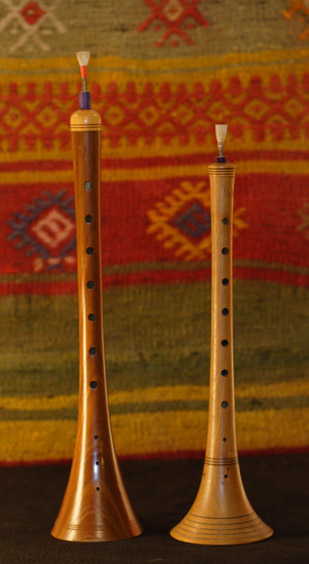
In Arabic music, a mizmār (Arabic: مزمار; plural مَزَامِير mazāmīr) is any single or double reed wind instrument. In Egypt and the Levant (Lebanon, Syria, Palestine and Jordan) the term mizmar usually refers to the conical shawm that is called zurna in Turkey and Armenia.
The mizmar is traditionally crafted from a single piece of wood, such as apricot or plum, though modern versions may use metal for durability. Its conical body, typically 30-40 cm long, narrows from the base to the top and features seven finger holes and a thumb hole for pitch control. The double reed, made from a desert plant called Hagna, is attached via a bocal, a small metal or wooden tube, which enhances airflow precision. The instrument’s design allows for its distinctive sharp, penetrating sound, ideal for outdoor settings like weddings and festivals.
Other double-reed instruments




More instruments from Egypt

Frequently asked questions
What does a mizmar sound like?
As one of the double-reed instruments, its sound comes from the way two reeds beat against each other.
What type of instrument is the mizmar?
It is classified as double-reed instruments (Hornbostel–Sachs 422.112.2).
Where does the mizmar come from?
The mizmar originates from Egypt.
Sources & credits
- Wikidata Q1179086 – CC0
- Wikipedia: Mizmar (instrument) – CC BY-SA 4.0
- Image by dalbera from Paris, France – CC BY 2.0