Listen to the Nadaswaram
Tip: press play to see the sound's live frequency spectrum in blue over the waveform.
How the Nadaswaram makes its sound
In the Hornbostel–Sachs system, which classifies instruments by how they produce sound, the Nadaswaram belongs to the double-reed instruments: two reeds beat against each other – oboes, bassoons, shawms and the duduk.
More broadly it is one of the aerophones (wind instruments), where sound comes from vibrating air.
Press play above and watch the spectrum: the evenly spaced peaks are harmonics, and their relative strength is what gives the instrument its character.
From Wikipedia
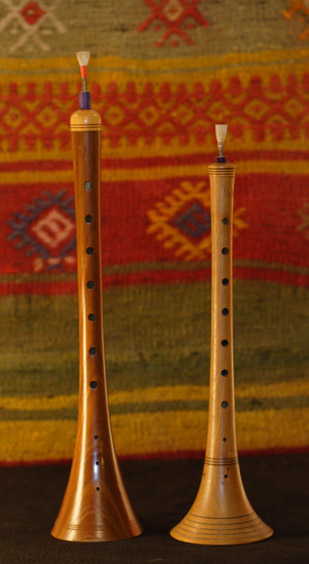
The nadaswaram (Tamil: நாதஸ்வரம்) (Malayalam: നാദസ്വരം) is a double reed wind instrument from Tamil Nadu. It is used as a traditional classical instrument in Tamil Nadu, Andhra Pradesh, Telangana, Karnataka, Kerala and in the northern and eastern parts of Sri Lanka.
This instrument is "among the world's loudest non-brass acoustic instruments". It is a wind instrument partially similar to the North Indian shehnai, but much longer, with a hardwood body, and a large flaring bell made of wood or metal, and also with a double reed rather than a quadruple reed.
Other double-reed instruments




Frequently asked questions
What does the Nadaswaram sound like?
Listen to 1 recording on this page. As one of the double-reed instruments, its sound comes from the way two reeds beat against each other.
What type of instrument is the Nadaswaram?
It is classified as double-reed instruments (Hornbostel–Sachs 422.112.2).
Sources & credits
- Kole Basava performers playing nadaswaram, Bengaluru, Karnataka, India by Subhashish Panigrahi – CC BY-SA 4.0 · Wikimedia Commons
- Wikidata Q1611652 – CC0
- Wikipedia: Nadaswaram – CC BY-SA 4.0
- Image by Ashwin Kamath from USA – CC BY 2.0