How the oboe da caccia makes its sound
In the Hornbostel–Sachs system, which classifies instruments by how they produce sound, the oboe da caccia belongs to the double-reed instruments: two reeds beat against each other – oboes, bassoons, shawms and the duduk.
More broadly it is one of the aerophones (wind instruments), where sound comes from vibrating air.
Its timbre – the colour that lets you tell it apart from other instruments playing the same note – comes from the mix of overtones its body and resonator emphasise.
From Wikipedia
The oboe da caccia, also sometimes referred to as an oboe da silva, is a double reed woodwind instrument in the oboe family, pitched a fifth below the oboe and used primarily in the Baroque period of European classical music. It has a curved tube, and in the case of instruments by Eichentopf (and modern copies of same), a brass bell, unusual for an oboe.
Its range is close to that of the cor anglais—that is, from the F below middle C (notated C4 but sounding F3) to the D above the treble staff (notated D6 but sounding G5). The oboe da caccia is thus a transposing instrument in F. The notated range is identical to that of the soprano baroque oboe, and with a good reed, all registers speak very easily. Johann Sebastian Bach tended to favor the middle and lowest registers, however, perhaps because they are the most characteristic ones for this instrument.
Other double-reed instruments


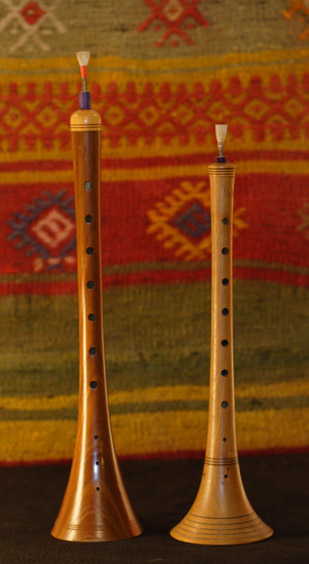


Frequently asked questions
What does an oboe da caccia sound like?
As one of the double-reed instruments, its sound comes from the way two reeds beat against each other.
What type of instrument is the oboe da caccia?
It is classified as double-reed instruments (Hornbostel–Sachs 422.112-71).
Sources & credits
- Wikidata Q1760274 – CC0
- Wikipedia: Oboe da caccia – CC BY-SA 4.0
- Image by Takashi Ogawa – CC BY-SA 3.0