How the piccolo oboe makes its sound
In the Hornbostel–Sachs system, which classifies instruments by how they produce sound, the piccolo oboe belongs to the double-reed instruments: two reeds beat against each other – oboes, bassoons, shawms and the duduk.
More broadly it is one of the aerophones (wind instruments), where sound comes from vibrating air.
Press play above and watch the spectrum: the evenly spaced peaks are harmonics, and their relative strength is what gives the instrument its character.
From Wikipedia
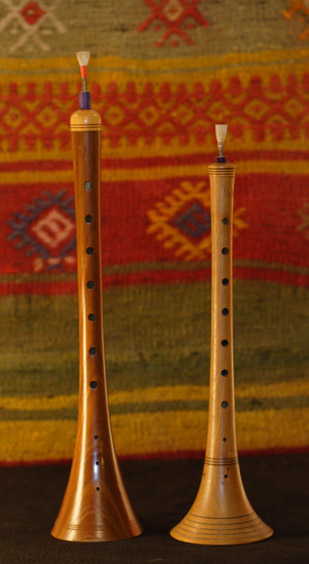
The piccolo oboe, also known as the piccoloboe or sopranino oboe and historically called an oboe musette (or just musette), is the smallest and highest pitched member of the oboe family. Pitched in E♭ or F above the regular oboe (i.e. notated a minor third or perfect fourth lower than sounding), the piccolo oboe is a sopranino version of the oboe, comparable to the E♭ clarinet. It is most commonly found in early 20th-century marching band music, and more rarely in chamber music ensembles or contemporary compositions.
Other double-reed instruments




Frequently asked questions
What does a piccolo oboe sound like?
As one of the double-reed instruments, its sound comes from the way two reeds beat against each other.
What type of instrument is the piccolo oboe?
It is classified as double-reed instruments (Hornbostel–Sachs 422.112-71).
Sources & credits
- Wikidata Q602719 – CC0
- Wikipedia: Piccolo oboe – CC BY-SA 4.0
- Image by Lutralutra, Editor/Bearbeiter User:Gisbert K – CC BY-SA 3.0