How the rhaita makes its sound
In the Hornbostel–Sachs system, which classifies instruments by how they produce sound, the rhaita belongs to the double-reed instruments: two reeds beat against each other – oboes, bassoons, shawms and the duduk.
More broadly it is one of the aerophones (wind instruments), where sound comes from vibrating air.
Players shape its sound through technique and materials; the resonating body filters the raw vibration, boosting some harmonics and damping others.
From Wikipedia
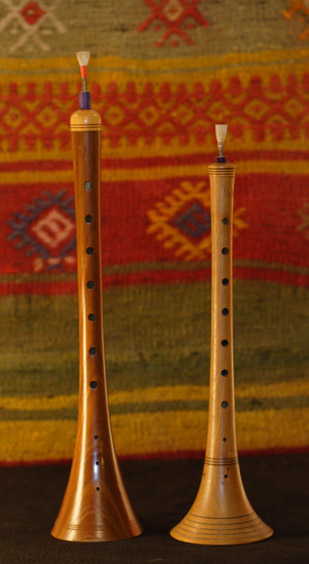
The rhaita or ghaita (Arabic: غيطة, romanized: ghayṭa) is a double reed instrument from the Maghreb, specifically Morocco, Algeria, Libya, Mauritania, and occasionally Tunisia. It is nearly identical in construction to the Arabic mizmar and the Turkish zurna. The distinctive name owes to a medieval Gothic-Iberian influence. In southern Iberia, various sorts of wind instruments, including the related shawm, are known as gaitas, but in northern Iberia gaita refers only to bagpipes.
The rhaita was featured in The Lord of the Rings soundtracks by Howard Shore, specifically in the Mordor theme. American composer John Corigliano calls one of the movements of his 1975 Concerto for Oboe and Orchestra "Rhaita Dance", asking the oboist to imitate a rhaita by pushing the reed further into their mouth. In 1981 while composing the soundtrack to Altered States Corigliano again called for oboists to mimic the rhaita sound during Three Hallucinations.
Other double-reed instruments




Frequently asked questions
What does a rhaita sound like?
As one of the double-reed instruments, its sound comes from the way two reeds beat against each other.
What type of instrument is the rhaita?
It is classified as double-reed instruments (Hornbostel–Sachs 422.112).
Where does the rhaita come from?
The rhaita originates from North Africa.
Sources & credits
- Wikidata Q7320165 – CC0
- Wikipedia: Rhaita – CC BY-SA 4.0
- Image by Schorle – CC BY-SA 3.0