Listen to the suona
Tip: press play to see the sound's live frequency spectrum in blue over the waveform.
How the suona makes its sound
In the Hornbostel–Sachs system, which classifies instruments by how they produce sound, the suona belongs to the double-reed instruments: two reeds beat against each other – oboes, bassoons, shawms and the duduk.
More broadly it is one of the aerophones (wind instruments), where sound comes from vibrating air.
Players shape its sound through technique and materials; the resonating body filters the raw vibration, boosting some harmonics and damping others.
From Wikipedia
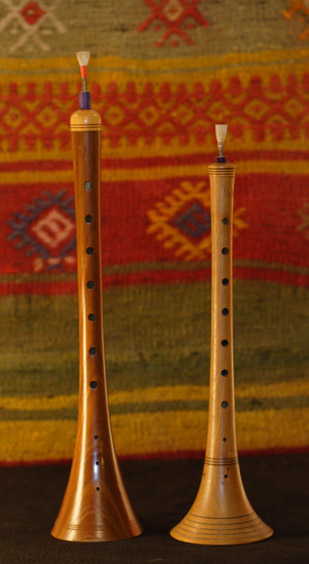
The suona, also called dida, laba or haidi, is a traditional double-reeded Chinese musical instrument. The suona's basic design originated in ancient Iran, then called "Sorna". It appeared in China around the 3rd century and it's also popular in parts of northern and southern China, including Shandong, Henan, Hebei, Shanxi, Shaanxi, Gansu, Northeast China, Guangdong, Fujian, and other regions. It has a distinctively loud and high-pitched sound, and was used frequently in Chinese traditional music ensembles, particularly in those that perform outdoors. It was an important instrument in the folk music of northern China, particularly in provinces of Shandong and Henan, where it has long been used for festival and military purposes. It is still being used, in combination with sheng mouth organs, gongs, drums, and sometimes other instruments in weddings and funeral processions. Such wind and percussion ensembles are called chuida (Chinese: 吹打; pinyin: chuīdǎ; Zhuyin Fuhao: ㄔㄨㄟ ㄉㄚˇ) or guchui (鼓吹; gǔchuì; ㄍㄨˇ ㄔㄨㄟˋ; this name refers to the suona itself in Taiwanese Hokkien). It was also common in the ritual music of Southeast China. In Chinese culture it was an essential element of ritual music that accompanied Daoist performances of both auspicious and inauspicious rites, i.e., those for both the living and the dead. One of the most famous pieces that uses suona as the leading instrument is called Bǎiniǎocháofèng (百鳥朝鳳), or "Hundred Birds Worship the Phoenix". The movie Song of the Phoenix casts the rise and fall of the popularity of suona in modern Chinese musical history. Suona music is filled with tradition and innovation, and is a timeless expression of Chinese folk culture, enriching the daily lives of folk workers. In Mainland China, Suona art was approved by the Chinese State Council to be included in the first batch of national intangible cultural heritage list on May 20, 2006.
Other double-reed instruments




Frequently asked questions
What does a suona sound like?
Listen to 1 recording on this page. As one of the double-reed instruments, its sound comes from the way two reeds beat against each other.
What type of instrument is the suona?
It is classified as double-reed instruments (Hornbostel–Sachs 422.112).
Sources & credits
- Suona by Francesc Fort – CC BY-SA 4.0 · Wikimedia Commons
- Wikidata Q2096912 – CC0
- Wikipedia: Suona – CC BY-SA 4.0
- Image – CC BY-SA 3.0