How the terpodion makes its sound
In the Hornbostel–Sachs system, which classifies instruments by how they produce sound, the terpodion belongs to the friction idiophones: the body is rubbed – the glass harmonica, singing bowls and the musical saw.
More broadly it is one of the idiophones, where the solid body of the instrument itself vibrates, without strings or a stretched membrane.
Press play above and watch the spectrum: the evenly spaced peaks are harmonics, and their relative strength is what gives the instrument its character.
From Wikipedia
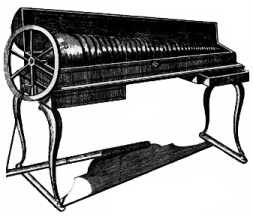
The terpodion or uranion is a keyboard instrument which produces sound using the same friction principle as the glass armonica. Instead of rotating glass bells, a wooden cylinder coated with a special mixture is rotated. Examples of these instruments can be seen in museums all over Europe, including museums in Copenhagen, Leipzig, Vienna, London, Brussels, Stockholm, Jevišovice and Frankfurt/Oder.
Other friction idiophones




Frequently asked questions
What does a terpodion sound like?
As one of the friction idiophones, its sound comes from the way the body is rubbed.
What type of instrument is the terpodion?
It is classified as friction idiophones (Hornbostel–Sachs 133.2).
Sources & credits
- Wikidata Q457992 – CC0
- Wikipedia: Terpodion – CC BY-SA 4.0
- Image by Winfried Mausolf – CC BY-SA 3.0