How the sarangi makes its sound
In the Hornbostel–Sachs system, which classifies instruments by how they produce sound, the sarangi belongs to the lutes: strings run parallel to a soundboard and along a neck – the family of the guitar, violin, sitar and oud.
More broadly it is one of the chordophones (string instruments), where sound comes from vibrating strings, amplified by a resonating body.
Players shape its sound through technique and materials; the resonating body filters the raw vibration, boosting some harmonics and damping others.
From Wikipedia
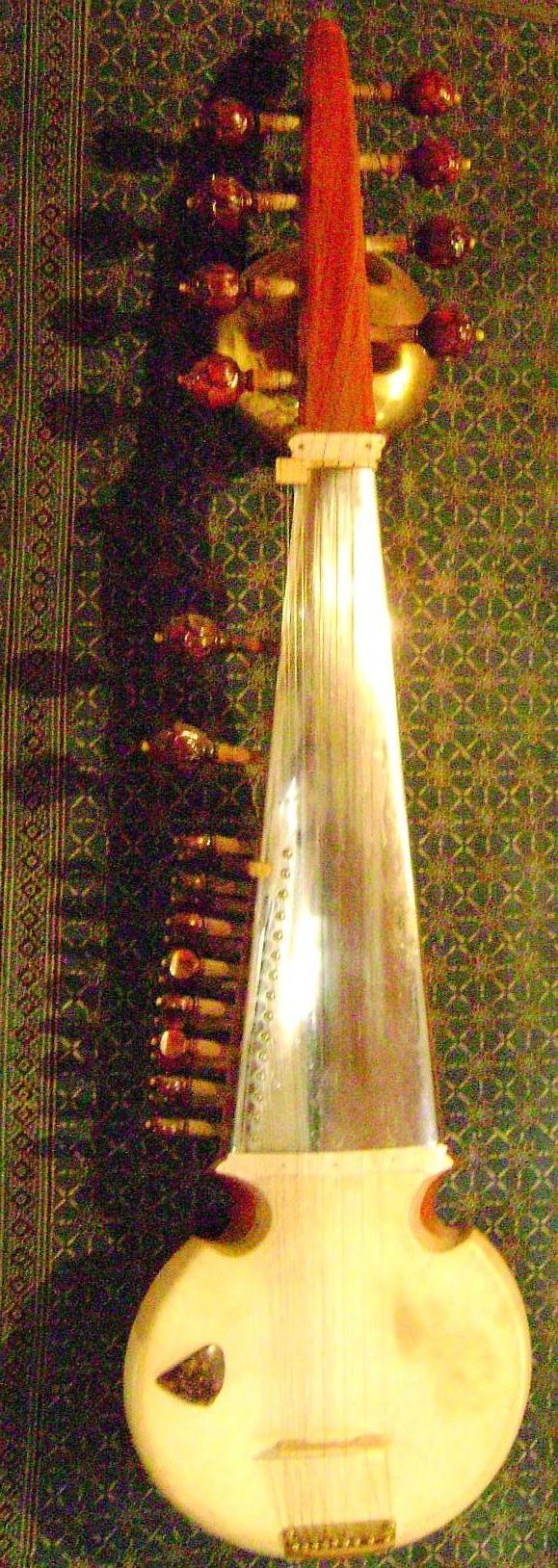
The sarangi is a bowed, short-necked three-stringed instrument played in traditional South Asian music. It is said to resemble the sound of the human voice through its ability to imitate vocal ornaments such as Gamaks or Gamakam (shakes) and meends (sliding movements). The Nepali sarangi is similar, but is a four-stringed, simpler folk instrument.
Other lutes


More instruments from India




Frequently asked questions
What does a sarangi sound like?
As one of the lutes, its sound comes from the way strings run parallel to a soundboard and along a neck.
What type of instrument is the sarangi?
It is classified as lutes (Hornbostel–Sachs 321.322-71).
Where does the sarangi come from?
The sarangi originates from India.
Sources & credits
- Wikidata Q608650 – CC0
- Wikipedia: Sarangi – CC BY-SA 4.0
- Image by dalbera from Paris, France – CC BY 2.0