Listen to the sitar
Tip: press play to see the sound's live frequency spectrum in blue over the waveform.
How the sitar makes its sound
In the Hornbostel–Sachs system, which classifies instruments by how they produce sound, the sitar belongs to the lutes: strings run parallel to a soundboard and along a neck – the family of the guitar, violin, sitar and oud.
More broadly it is one of the chordophones (string instruments), where sound comes from vibrating strings, amplified by a resonating body.
Players shape its sound through technique and materials; the resonating body filters the raw vibration, boosting some harmonics and damping others.
From Wikipedia
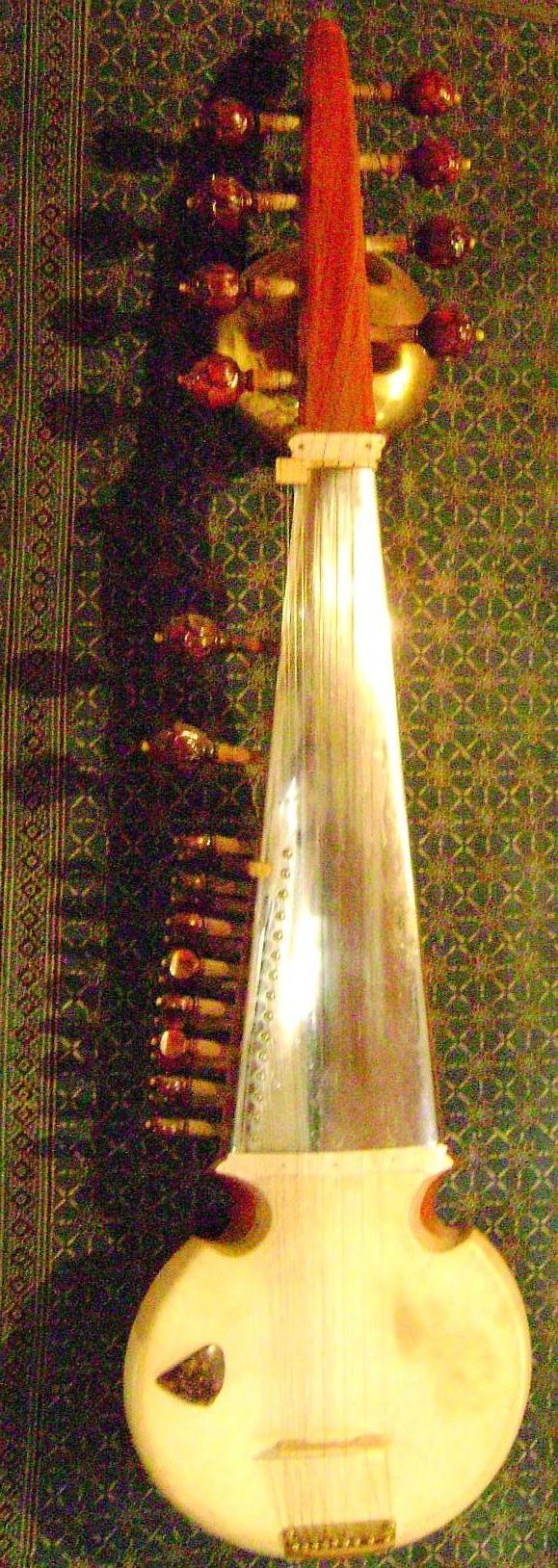
The sitar (English: or; IAST: sitāra) is a plucked stringed instrument, originating from the Indian subcontinent, used in Hindustani classical music. The instrument was invented in the 18th century, and arrived at its present form in 19th-century India. Khusrau Khan, an 18th-century figure of the Mughal Empire, has been identified by modern scholarship as the inventor of the sitar. According to most historians, he developed the sitar from the setar, an Iranian instrument of Abbasid or Safavid origin.
Used widely throughout the Indian subcontinent, the sitar became popularly known in the wider world through the works of Ravi Shankar, beginning in the late 1950s and early 1960s. The advent of psychedelic culture during the mid-to-late 1960s set a trend for the use of the sitar in Western popular music, with the instrument appearing on tracks by bands such as The Beatles, The Rolling Stones, Metallica and many others.
Other lutes


More instruments from India




Questions people ask
Real questions from the Stack Exchange community – follow a link to read the discussion.
Frequently asked questions
What does a sitar sound like?
Listen to 5 recordings on this page. As one of the lutes, its sound comes from the way strings run parallel to a soundboard and along a neck.
What type of instrument is the sitar?
It is classified as lutes (Hornbostel–Sachs 321.321-6).
Where does the sitar come from?
The sitar originates from India.
Sources & credits
- Ocean of Milk, Fast passages, Ranjit Makkuni -- Mahamaya Experience, sitar by Ranjitonthemove – CC BY-SA 4.0 · Wikimedia Commons
- The fury of Sitar (Antti Luode) by Antti Luode – CC BY 3.0 · Wikimedia Commons
- Sitar and simple beats (Antti Luode) by Antti Luode – CC BY 3.0 · Wikimedia Commons
- Living in a Sitar Nation (Antti Luode) by Antti Luode – CC BY 3.0 · Wikimedia Commons
- Relax Ay Sitar (Antti Luode) by Antti Luode – CC BY 3.0 · Wikimedia Commons
- Wikidata Q229205 – CC0
- Wikipedia: Sitar – CC BY-SA 4.0
- Image by Sathyadeep – Public domain