How the sarinda makes its sound
In the Hornbostel–Sachs system, which classifies instruments by how they produce sound, the sarinda belongs to the lutes: strings run parallel to a soundboard and along a neck – the family of the guitar, violin, sitar and oud.
More broadly it is one of the chordophones (string instruments), where sound comes from vibrating strings, amplified by a resonating body.
Players shape its sound through technique and materials; the resonating body filters the raw vibration, boosting some harmonics and damping others.
From Wikipedia
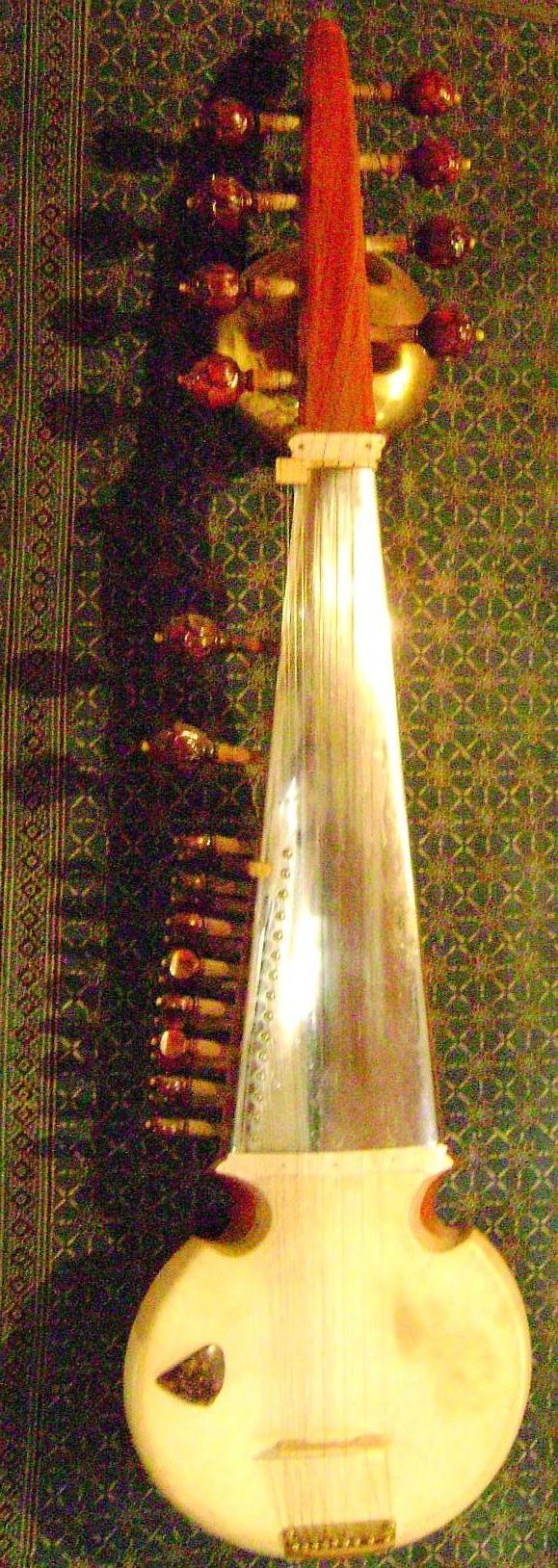
Sarinda (Bengali:সরিণ্ডা, Assamese:চৰিণ্ডা, Punjabi:ਸਰਿੰਦ, Urdu:سرندا; also spelled saranda) is a traditional bowed string musical instrument originating from the Indian subcontinent. It is crafted from a single block of wood with a hollow resonator. The instrument has three main playing strings and with a total of thirty-six sympathetic strings. These strings cascade down a slender waist and traverse an oval-shaped resonating chamber, which is partially adorned with animal skin. It is played while sitting on the ground in a vertical orientation. The sarinda is an integral part of the folk music traditions of Bangladesh, India, and parts of Pakistan. It is similar to the sarangi, lute, and the fiddle. It is the sole accompaniment for a soloist or group folk singera.
Other lutes


More instruments from India



Frequently asked questions
What does a sarinda sound like?
As one of the lutes, its sound comes from the way strings run parallel to a soundboard and along a neck.
What type of instrument is the sarinda?
It is classified as lutes (Hornbostel–Sachs 321.321-71).
Where does the sarinda come from?
The sarinda originates from India.
Sources & credits
- Wikidata Q348878 – CC0
- Wikipedia: Sarinda (instrument) – CC BY-SA 4.0
- Image – Public domain